Alana Persson
Recruits
(0)
About Alana
Take action on behalf of Alana
Goals
-
Total Recruits50No recruits counted.
Recent Activity
-
Voting Rights Act
Protecting Voting Rights, Advancing Representation: The Voting Rights Act and What It Means for Women
Overview: What Is the Voting Rights Act?
The Voting Rights Act (VRA) of 1965 is one of the most consequential pieces of civil rights legislation in American history. Signed into law at the height of the civil rights movement, it was designed to dismantle the systematic disenfranchisement of Black Americans — particularly in the South — by prohibiting discriminatory voting practices and establishing federal oversight of elections in jurisdictions with histories of suppression.
At its core, the VRA affirms a foundational democratic principle: that the right to vote must be paired with a meaningful opportunity to be represented. Securing the ballot is the floor, not the ceiling.
For nearly 60 years, the VRA has served as a cornerstone of representative democracy, ensuring that communities — regardless of race, color, or background — have a fair opportunity to elect candidates who reflect their interests and lived experiences. That promise of fair representation has never been automatic. It has required vigilant enforcement and sustained commitment. Today, those protections face unprecedented challenges — and understanding what's at stake has never been more urgent.
The law operates through several key provisions. Section 2 prohibits any voting practice or procedure that discriminates on the basis of race, color, or membership in a language-minority group, and it applies nationwide. Section 5 (now largely gutted by the Supreme Court's 2013 decision in Shelby County v. Holder) required certain jurisdictions with histories of discrimination to seek federal preclearance before changing any voting laws or procedures. Together, these provisions created a framework for accountability that fundamentally shaped American elections for decades.
The VRA was the product of generations of organizing, sacrifice, and courage — particularly by Black women whose leadership has long been the backbone of democratic progress in this country. Protecting and strengthening its promise is not a partisan cause. It is a democratic one.
How the VRA Impacts Women — Especially Women of Color
RepresentWomen's research makes one conclusion unmistakable: voting rights protections and representation outcomes are deeply interconnected. When safeguards against discrimination, vote dilution, and exclusion are strong, women — particularly women of color and members of language-minority communities — are more likely to participate, to run for office, and to win. When those safeguards are weak, the effects ripple outward, narrowing who has access to political power.
The VRA matters for women's representation in several distinct and compounding ways.
- Vote dilution is a women's issue. Vote dilution occurs when election structures allow people to cast ballots but consistently prevent certain groups of voters from translating their shared preferences into representation. This can happen in systems like at-large elections or winner-take-all, single-seat districts, where a cohesive majority can sweep every available seat — even when a substantial share of the community votes together for different candidates. Over time, those voters may participate fully and still never see themselves reflected in governing bodies. Not because of a lack of engagement, but because of how the system operates. Women, and especially women of color, have historically been among those most affected by these structural dynamics.
- Discrimination and vote dilution do not require malicious intent. Even well-intentioned election practices can produce unfair outcomes over time. The VRA's focus on impact and results — rather than intent alone — is precisely what makes it a meaningful tool for addressing systemic inequity.
-
Proportional remedies expand opportunity for women. RepresentWomen's research shows that remedies for voting rights violations that address underlying systems, such as proportional voting structures, are among the most effective approaches to improving representation outcomes. In jurisdictions where such remedies have been implemented, governing bodies have become more reflective of the communities they serve, strengthening democratic legitimacy and accountability.
- Portland, Oregon, offers one compelling example. Following the city's adoption of council expansion alongside proportional ranked choice voting as a remedy, women now hold half of all city council seats, and four of the six women elected are women of color — making it the most representative council in the city's history. These outcomes demonstrate what becomes possible when voting rights protections are paired with systems designed to prevent vote dilution and foster fair representation.
The VRA's language access and participation provisions matter. Barriers to voting disproportionately affect women — especially caregivers, older women, and women in language-minority communities. When participation is limited, women's leadership is often the first to be excluded. Provisions that ensure voting materials and assistance are available where there is demonstrated need, and that protect older voters, voters with disabilities, and voters facing intimidation or misinformation, ensure that participation is real, not theoretical.
Women whose leadership has long sustained civic life are too often the first to be excluded when democratic systems fail. The right to vote is inseparable from the right to be represented, and representation must include women.
What the Data Tell Us
RepresentWomen's analysis found that 54 — or 36% — of the 148 majority-minority districts identified by Ballotpedia (2024) are currently represented by women in Congress. In the 11 states most likely to face redistricting pressure following an adverse ruling in Callais, up to 36 majority-minority districts could be redrawn, 12 of which are currently represented by women in the House of Representatives.
What happens to those women and their constituents if those lines change is an open question. Comprehensive data tracking how Section 2 protections have specifically shaped women's pathways to office, and what happens when those protections are removed, remains limited. What RepresentWomen's broader research does show is that when election structures change, women — particularly women of color — are disproportionately affected.
infogram_0_98efdbfc-f05b-4ab1-b9b0-c0d4cbaa85ce2026 Majority-Minority Districts - Maphttps://e.infogram.com/js/dist/embed.js?B1Otext/javascript
A Critical Moment: Louisiana v. Callais and the Future of the VRA
The VRA is currently facing one of its most serious legal threats in decades — and a Supreme Court decision with profound implications for voting rights and representation is still pending.
Louisiana v. Callais (consolidated with Robinson v. Callais) is a landmark redistricting case before the U.S. Supreme Court centering on the constitutionality of Louisiana's congressional map — and, more broadly, on the future of Section 2 of the VRA itself.
The background: Following the 2020 census, Louisiana's Republican-controlled legislature drew a congressional map that gave Black voters — who make up roughly one-third of the state's population — the opportunity to elect their preferred candidate in only one of its six congressional districts. Black voters and civil rights organizations challenged the map under Section 2 of the VRA. After years of litigation, courts determined the map was likely unlawful, and the legislature was directed to draw a second majority-Black district. When that new map was challenged as an unconstitutional racial gerrymander, the case reached the Supreme Court.
What makes this case different: The Court first heard oral arguments in March 2025, but made the rare decision to schedule the case for reargument — narrowing its focus to a newly framed question: whether the intentional creation of a second majority-minority congressional district violates the 14th or 15th Amendments to the Constitution. This reframing put Section 2 itself squarely in the crosshairs. Reargument was heard on October 15, 2025. A decision is still pending.
What's at stake: Court observers noted that the Court's conservative majority appeared ready to significantly limit or fundamentally restrict the use of Section 2 in redistricting. A ruling that weakens or dismantles Section 2 could have sweeping consequences — not only for congressional maps, but for state legislatures, city councils, school boards, and local governing bodies across the country. It could eliminate majority-minority districts as a remedy for proven voting rights violations, make gerrymandering effectively consequence-free, and remove one of the last remaining checks on discriminatory election practices. The Brennan Center for Justice has noted at least 30 active cases currently asserting claims under Section 2 of the VRA, all of which could be affected.
The stakes for women: A gutted VRA would deepen the structural barriers that already prevent women of color from accessing political power. The VRA has served as a critical legal framework for challenging election systems that dilute the voting strength of communities whose preferred representatives are disproportionately women. Weakening it would narrow, not expand, the pipeline to leadership.
infogram_0_7abbbf80-9bc2-4864-985a-bc09688a59872026 Women in Majority-Minority Districts - Maphttps://e.infogram.com/js/dist/embed.js?B1Otext/javascriptWe are watching this case closely and will continue to update this page as developments unfold. In the meantime, we encourage you to explore resources from the Brennan Center for Justice, FairVote, and NAACP Legal Defense Fund for additional context on the case.
State Voting Rights Acts: Strengthening the Promise at the Local Level
With federal protections facing sustained legal attack, state-level Voting Rights Acts have become an increasingly critical line of defense — and opportunity.
What is a State VRA?
State Voting Rights Acts are laws passed at the state level that mirror, extend, or strengthen the protections of the federal VRA within a given state. They can cover voting districts, election administration, language access, and anti-dilution provisions, and in some cases go further than the federal law in scope or enforcement. Importantly, in many instances, state VRAs include provisions that allow for proportional and ranked choice voting remedies when discriminatory practices are found, providing pathways to the kinds of structural change that RepresentWomen's research shows are most effective at advancing women's representation.
As federal courts have chipped away at VRA protections — from the Supreme Court's gutting of Section 5 preclearance in Shelby County v. Holder (2013) to the ongoing threat posed by Callais — states have an opportunity, and a responsibility, to fill the gap. State VRAs are not a fallback. They are proactive, affirmative commitments to democracy.
RepresentWomen's Work on State VRAs: A Case Study in Vermont
RepresentWomen has been actively engaged in efforts to advance state-level voting rights protections. In Vermont, we expressed strong support for the Vermont Voting Rights Act (S-0298) — legislation that would establish comprehensive protections against vote denial and dilution, establish transparent preclearance and public notice processes for election changes, provide language access provisions, and protect voters from intimidation and misinformation.
We testified before the Vermont Senate Committee on Government Operations in January 2026, making clear that this legislation is critical not only to protecting the right to vote but to ensuring the right to be meaningfully represented. Vermont has an opportunity to lead — and the Vermont VRA is a model for how states can take decisive action to strengthen democracy in the face of federal rollback.
States with Voting Rights Acts
Several states have already passed or are actively pursuing their own voting rights legislation. For a current map and overview of state-level VRAs across the country, see our map below:
infogram_0_0908329c-6526-4da1-bf37-1999dbeb95572026 State VRAshttps://e.infogram.com/js/dist/embed.js?B1Otext/javascript
In Her Own Words: Lani Guinier on Democracy and Representation
"I am a democratic idealist who believes that politics need not be forever seen as 'I win, you lose,' a dynamic in which some people are permanent monopoly winners and others are permanently excluded losers." — Lani Guinier
Lani Guinier (1950–2022) was a groundbreaking civil rights lawyer, Harvard Law School's first tenured woman of color, and one of the most visionary legal thinkers on voting rights and democratic representation of her generation. Her scholarship challenged winner-take-all elections as structurally discriminatory — not just against racial minorities, but against women and other underrepresented communities. She was a fierce advocate for proportional voting systems as the most effective path to fair, inclusive representation.
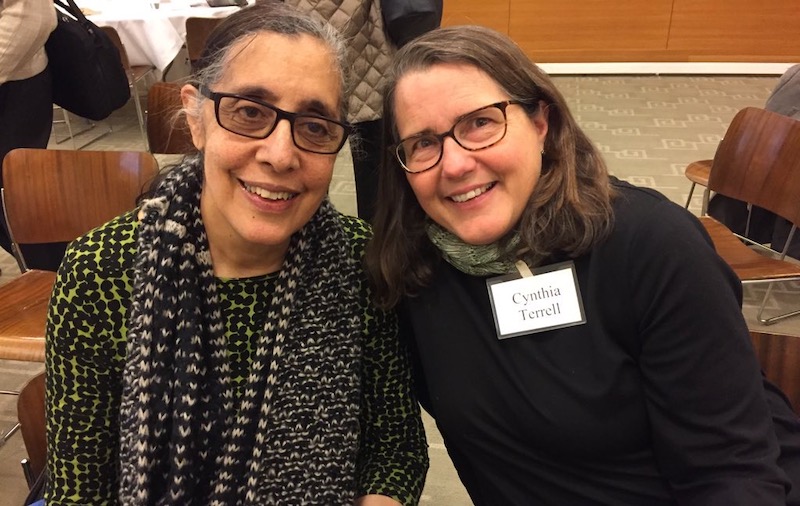
RepresentWomen's founder and Executive Director Cynthia Richie Terrell first met Guinier 40 years ago and came to know her and her work deeply. Guinier's legacy is evident in the many organizations working today for election reform — including RepresentWomen itself.
Take Action: Support Voting Rights
Protecting the VRA is inseparable from advancing women's representation. Here's how you can get involved:
- Learn More — Watch our recent Solutions Series Webinar on the VRA!
- RepresentWomen's Democracy Solutions Series has featured conversations on voting rights and representation reform.
-
Explore Key Resources
- Brennan Center for Justice
- FairVote
- NAACP Legal Defense Fund
Stay Connected
Sign up for RepresentWomen's newsletter to receive updates on VRA litigation, state-level advocacy, and opportunities to take action.
-
Tori Wyman - Researcher
Tori Wyman (she/her) is a Researcher at RepresentWomen. While based in Washington, D.C., Tori grew up in New Hampshire, where her passion for electoral systems originated. Her frustration with her home state’s electoral system sparked her research into other states’ systems and how they differ in accessibility, representation, and accountability. This led her to analyze international electoral systems, studying abroad in Spain and Austria, and interning at the International Institute for Democracy and Electoral Assistance in Sweden.
Before joining RepresentWomen, Tori worked at the International Foundation for Electoral Systems, working on democracy and civic education programs in the Middle East and Northern Africa. She holds a Master’s degree in International Relations from the Josef Korbel School of Global and Public Affairs.
In her free time, Tori enjoys attending sporting events, playing pickleball, learning to ice skate, and traveling.
-
Jacqueline Crespo - Researcher
Jacqueline Crespo is a Researcher at RepresentWomen based in Tampa, Florida. She is passionate about election system reform and equal representation, with a particular interest in how electoral design shapes candidate opportunity, voter access, and governing outcomes. She is committed to strengthening election security at the ultra-local level to build trust in democratic processes.Jacqueline earned her BA in Political Science from the University of Tampa in 2021 and her MPAP from American University in 2025. Her past research has explored topics of ultra-local election administration, access to affordable housing in climate-vulnerable communities, and systemic inequities faced by marginalized populations.
Outside of work, Jacqueline enjoys spending time in the Florida sun and dreams of one day having a garden large enough to live off. She can often be found getting lost on a trail or cheering on the Tampa Bay Rays at a baseball game."
-
Ranked Choice Voting Day 2026
Thank you for celebrating RCV Day with RepresentWomen!
We appreciate everyone for celebrating Ranked Choice Voting Day with us on January 22nd!
The importance of ranked choice voting is multifaceted, and here at RepresentWomen, we strongly support this reform. As our Executive Director, Cynthia Richie Terrell, stated on Ranked Choice Voting Day:
"Building a thriving democracy in the United States requires strategies that address the root causes of the imbalance of power. That imbalance of power cannot be addressed successfully through trying to “win” the next election cycle for “our” side. Adopting better voting systems, campaign finance rules, and election processes are necessary ingredients to give us all real power to elect the candidates who represent us and the ability to hold them accountable.”
For those who missed our webinar, we strongly encourage you to listen in to the recording to hear from our wonderful guest panelists from across the RCV movement.
Our Speakers

Anna Kellar, Rank the Vote
Elise Orlick, FairVote Washington
Tamara Allen, UpVote Virginia
Perry Radford, NM Voters First
Tamaya Dennard, RepresentWomen
What Is Ranked Choice Voting Day?
Ranked Choice Voting Day is an annual moment held every year on January 23rd (1, 2, 3) to celebrate a proven, people-powered reform that strengthens democracy by giving voters more choice and candidates a fairer path to office.
Ranked choice voting (RCV) allows voters to rank candidates in order of preference, ensuring winners earn majority support while reducing vote-splitting and negative campaigning.
At RepresentWomen, we celebrate RCV Day because how we vote shapes who runs, who wins, and who leads — and RCV is one of the most effective systems reforms for advancing women’s political representation.
Why RepresentWomen Supports Ranked Choice Voting

Our research shows that women — especially women of color — face structural barriers in winner-take-all elections that discourage them from running and limit their chances of winning.
Ranked choice voting helps change that by:
-
Reducing the spoiler effect, so multiple women can run without being told to “wait their turn”
-
Encouraging coalition-building, not zero-sum competition
-
Lowering campaign costs by eliminating costly runoff elections
-
Shifting campaign tone, reducing negative attacks that disproportionately harm women candidates
-
Expanding voter choice, which benefits communities historically excluded from political power
RCV is not a silver bullet, but it is a powerful part of the systems-level change needed to reach gender-balanced governance.
Visit our Ranked Choice Voting website page to learn more!
Other RCV Resources:
Ranked Choice Voting Dashboard
Report: In Ranked Choice Elections, Women WIN
Memo: Ranked Choice Voting and Women's Representation
-
-
Alana Persson published Online Violence Against Black Women is a Systems Failure and a Threat to Democracy in Blog and OpEd Library 2026-01-02 13:55:13 -0500
Online Violence Against Black Women is a Systems Failure and a Threat to Democracy

Online harassment is not just a social media problem; it’s a systems failure that shapes who runs, who stays, and who leads. This piece examines how digital violence disproportionately impacts Black women in politics, operates as a structural barrier to women’s political power, and outlines the reforms needed to build safer, more equitable pathways to leadership as we head into a critical election cycle.
Read more -
2026 Visionary Women's Planner
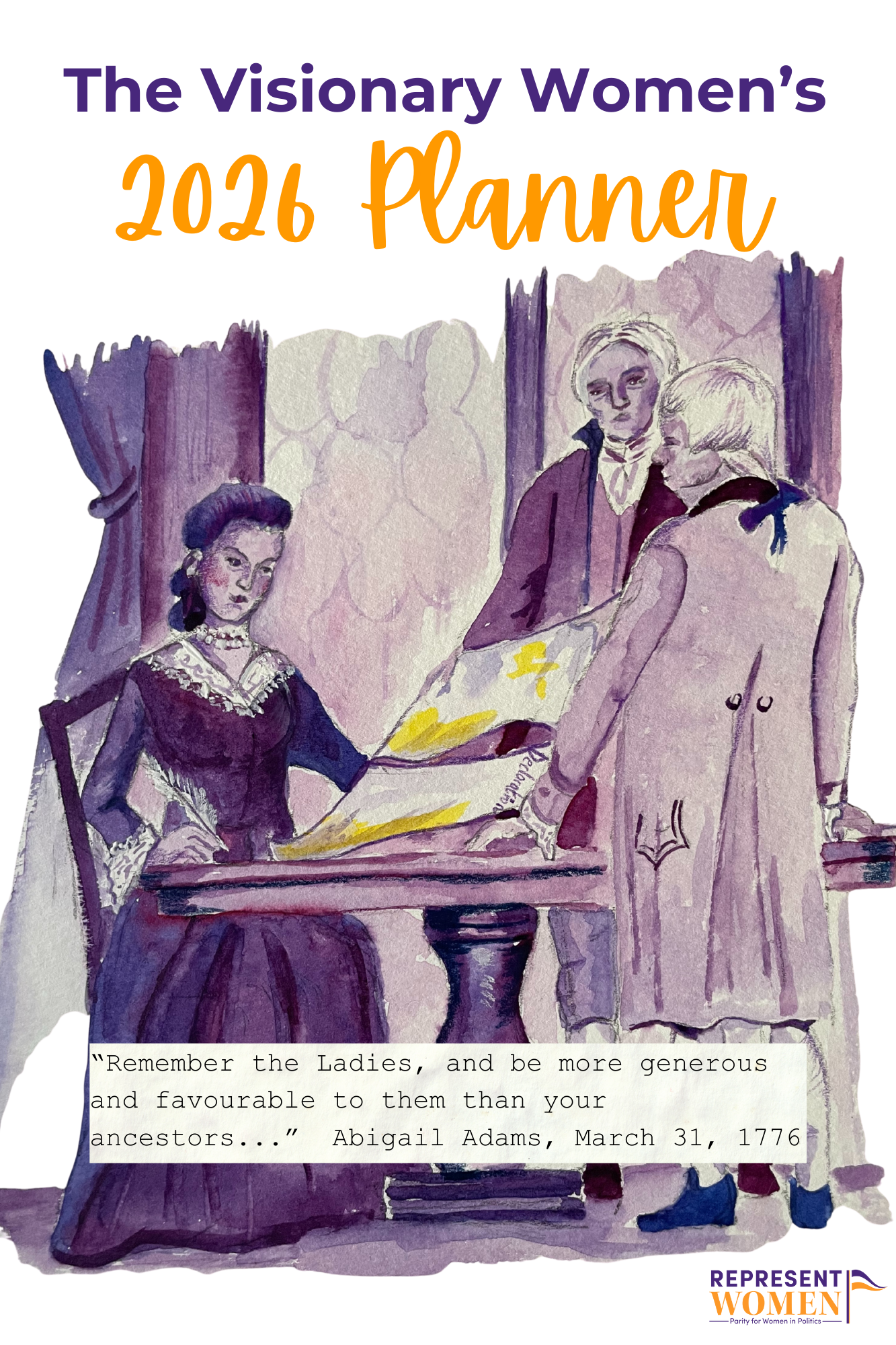
When we were invited to write about women who ran for the American presidency, we quickly realized how scattered the information was. The stories were extraordinary, but far too hard to find.
That experience sparked the idea for this planner.
We wanted a place that makes women’s leadership visible: celebrating milestones, honoring birthdays, and lifting up the women who shape our democracy.
Today, this planner reflects RepresentWomen’s belief in Women’s Power by Design — that representation grows when we build systems and tools that center women’s contributions. This work also comes to life each year through our Democracy Solutions Summit, the only national reform convening that centers women experts and elevates solutions for a more representative democracy.
As you move through these pages, we invite you to consider one question:
How might our democracy change if we designed our systems with women’s leadership in mind, and what role might you play in that story this year?
We’re proud to share the 2026 edition as a celebration of the women who came before us, the women inspiring us now, and the women who will lead us into the future.
We hope you all have a fantastic 2026!
-
Alana Persson published Ranked Choice Voting Is Moving Forward in Washington, D.C. in Blog and OpEd Library 2025-12-17 21:45:26 -0500
Ranked Choice Voting Is Moving Forward in Washington, D.C.
The D.C. Council voted to move forward with the on-time implementation of ranked choice voting for the 2026 elections, honoring the clear mandate delivered by voters. RepresentWomen is encouraged to see this commitment to democratic integrity upheld.
Read more -
Alana Persson published RepresentWomen Statement on Effort to Delay Ranked Choice Voting in D.C. in Blog and OpEd Library 2025-12-15 20:17:44 -0500
Ranked Choice Voting Is Ready for D.C. — The Council Should Be Too
The D.C. Council is voting tomorrow, Tuesday, December 16, on a last-minute attempt to delay the implementation of ranked choice voting (RCV), despite the fact that nearly 73% of DC voters approved it last year. Here's what you need to know.
Read more -
Alana Persson published Election Day 2025 How Cities are Redefining the Rules of Representation in Blog and OpEd Library 2025-11-04 13:19:48 -0500
Local Elections, National Impact: How Cities are Redefining the Rules of Representation
Today's elections will offer a glimpse into the future of American democracy — not just in who wins, but in how the systems that shape our elections determine who gets to lead. From the governor’s races in Virginia and New Jersey to mayoral contests in cities across America, these elections reflect a nation still grappling with the unfinished business of representation.
Read more -
Alana Persson published Protecting Voting Rights, Advancing Representation in Blog and OpEd Library 2025-10-17 14:36:35 -0400
Protecting Voting Rights, Advancing Representation
The Supreme Court case Louisiana v. Callais could reshape the Voting Rights Act and threaten hard-won progress toward equal representation. RepresentWomen explores what’s at stake for women — especially Black women — and why protecting the Voting Rights Act remains essential to building a truly representative democracy.
Read more -
Alana Persson published Proportional Ranked Choice Voting in Blog and OpEd Library 2025-10-09 04:56:22 -0400
Proportional Ranked Choice Voting (PRCV)

Across the United States, women remain underrepresented in every level of government. Winner-take-all elections reward incumbency, polarize communities, and lock out new voices — especially women, people of color, and independents. These rules don’t just shape outcomes; they shape who feels welcome to run in the first place.
Proportional Ranked Choice Voting (PRCV) offers a proven alternative. By combining the fairness of proportional outcomes with the accessibility of ranked choice ballots, PRCV ensures that nearly every voter helps elect someone they support. The result is leadership that better reflects our communities — and new opportunities for women to run, win, and lead.
PRCV isn’t just an idea. It has a long history in the United States, helped elect the first women to city councils in major cities, and continues to deliver diverse representation in Cambridge, MA today. And with Portland, Oregon, implementing the largest PRCV elections in modern history, the momentum is growing.
At RepresentWomen, we champion PRCV because it is the gold standard reform for building a gender-balanced democracy in our lifetimes.
Read our 2025 Parity in Portland, Oregon, Report
Read more -
Alana Persson published Proportional Representation Explained in Blog and OpEd Library 2025-10-09 03:22:52 -0400
Proportional Representation (PR)
Our democracy works best when everyone has a seat at the table. But under winner-take-all elections, too many voices are shut out — especially women, people of color, and independent voters.
Proportional representation offers a proven solution. Instead of one winner per district, multiple representatives are elected in proportion to the votes cast. This simple change opens the political process to more women and underrepresented candidates, fosters diverse coalitions, and reduces the polarization that hinders progress.
Proportional ranked choice voting, used around the world and gaining momentum in the U.S., is the gold standard for delivering on this promise. It levels the playing field and moves us closer to gender-balanced governance in our lifetimes.
Read more -
Alana Persson published Ranked Choice Voting Explained in Blog and OpEd Library 2025-10-09 02:29:30 -0400
Ranked Choice Voting (RCV)
Ranked choice voting (RCV) is a powerful reform that transforms the way we vote, changing who runs, who wins, and who leads — and increasing women’s political power. Across the country, RCV is breaking down barriers and creating new opportunities for women and diverse leaders to represent their communities.
Under our current system, too many voters feel their voices don’t count. Candidates can win with far less than majority support, women and people of color are often told to “wait their turn” to run for office, and campaigns become increasingly divisive and costly. These structural barriers hinder progress toward gender parity and prevent the government from accurately reflecting the people it serves.
RCV is a proven solution. By eliminating vote-splitting, rewarding coalition-building, and empowering voters to rank candidates in order of preference, RCV creates fairer, more inclusive elections. It strengthens democracy while leveling the playing field for women and underrepresented candidates — and it’s already reshaping leadership and governance in places like Alaska, Maine, and New York City.
Explore our interactive dashboard to see where RCV is already making an impact across the U.S.:
Read moreinfogram_0_f45a9b75-7958-4bcd-b51b-adb30abd22e42022 RCV Dashboardhttps://e.infogram.com/js/dist/embed.js?wyMtext/javascript -
Alana Persson published Voter Registration Day and Majority Rules in Blog and OpEd Library 2025-09-16 17:47:38 -0400
Voter Registration Day and Majority Rules
This National Voter Registration Day, we’re reminded that the Virtuous Cycle of Change starts with participation — and to get in the spirit of change, don’t forget to watch the new version of Majority Rules!
Read more -
Alana Persson published Advancing Women’s Political Representation and Democracy | CFR Conversation with Cynthia Richie Terrell in Blog and OpEd Library 2025-08-29 23:12:03 -0400
Advancing Women’s Political Representation and Democracy | CFR Conversation with Cynthia Richie Terrell
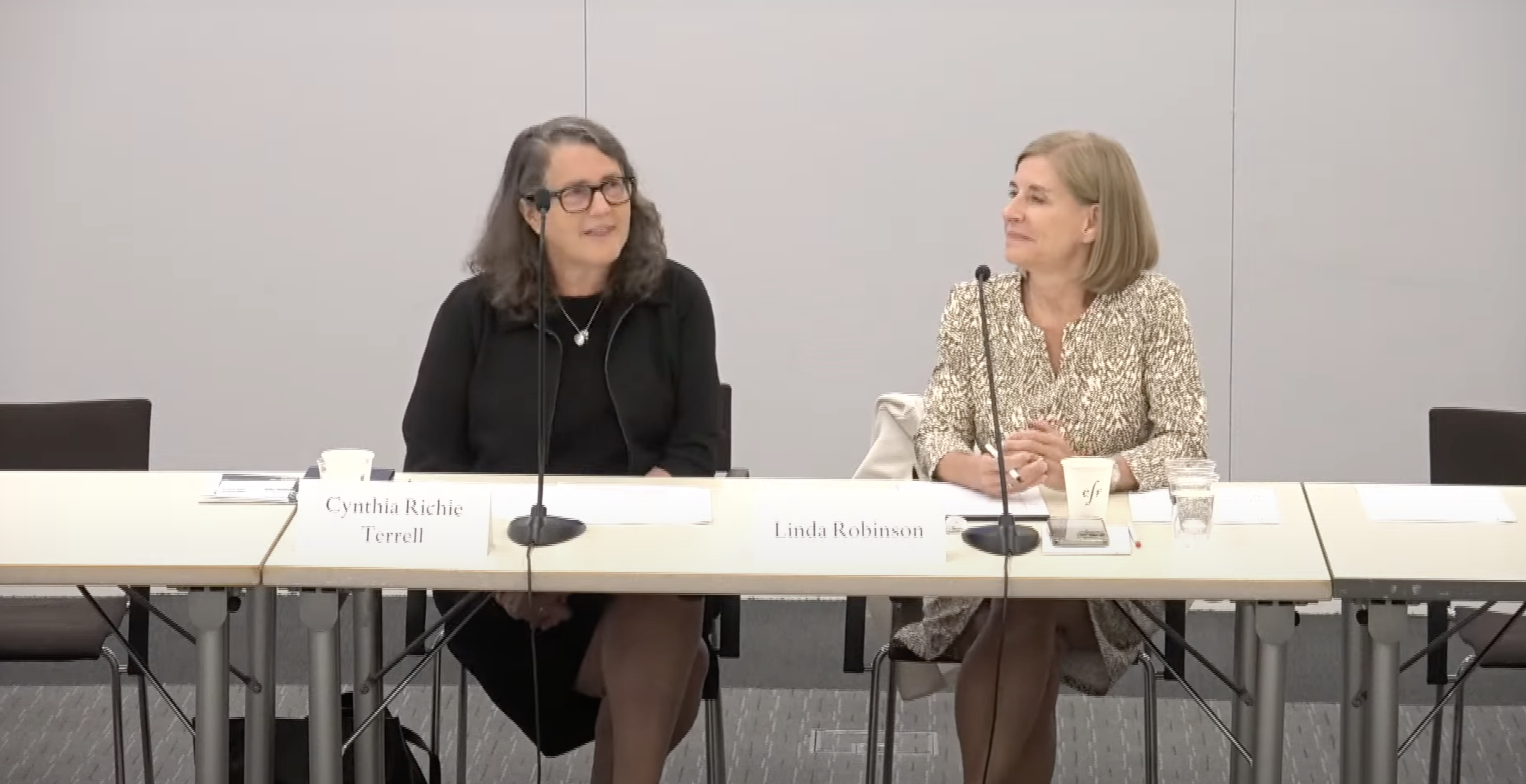
At the Council on Foreign Relations, RepresentWomen’s Cynthia Richie Terrell joins Linda Robinson to discuss why women’s political progress is stalling worldwide — and the structural reforms needed to strengthen democracy.
Read more -
2025 Gender Parity Index Report
Tracking Women’s Political Representation Across the United States
For over a decade, RepresentWomen’s Gender Parity Index (GPI) has measured progress toward gender‑balanced governance in all 50 states. Explore the latest scores, see how your state ranks, and learn what it will take to achieve true parity.
Since 2013, the GPI has provided an annual snapshot of women’s political representation across national, state, and local offices. Each state receives a score (0–100), a letter grade, and a ranking to track progress over time.
Now in its 12th year, the GPI shows a clear truth: progress is slow, uneven, and easily reversed without intentional reforms. No state has reached “perfect parity,” and women — especially women of color — remain underrepresented at every level.
This page serves as your hub for the latest GPI findings, past reports, and resources to bring the conversation to your community.
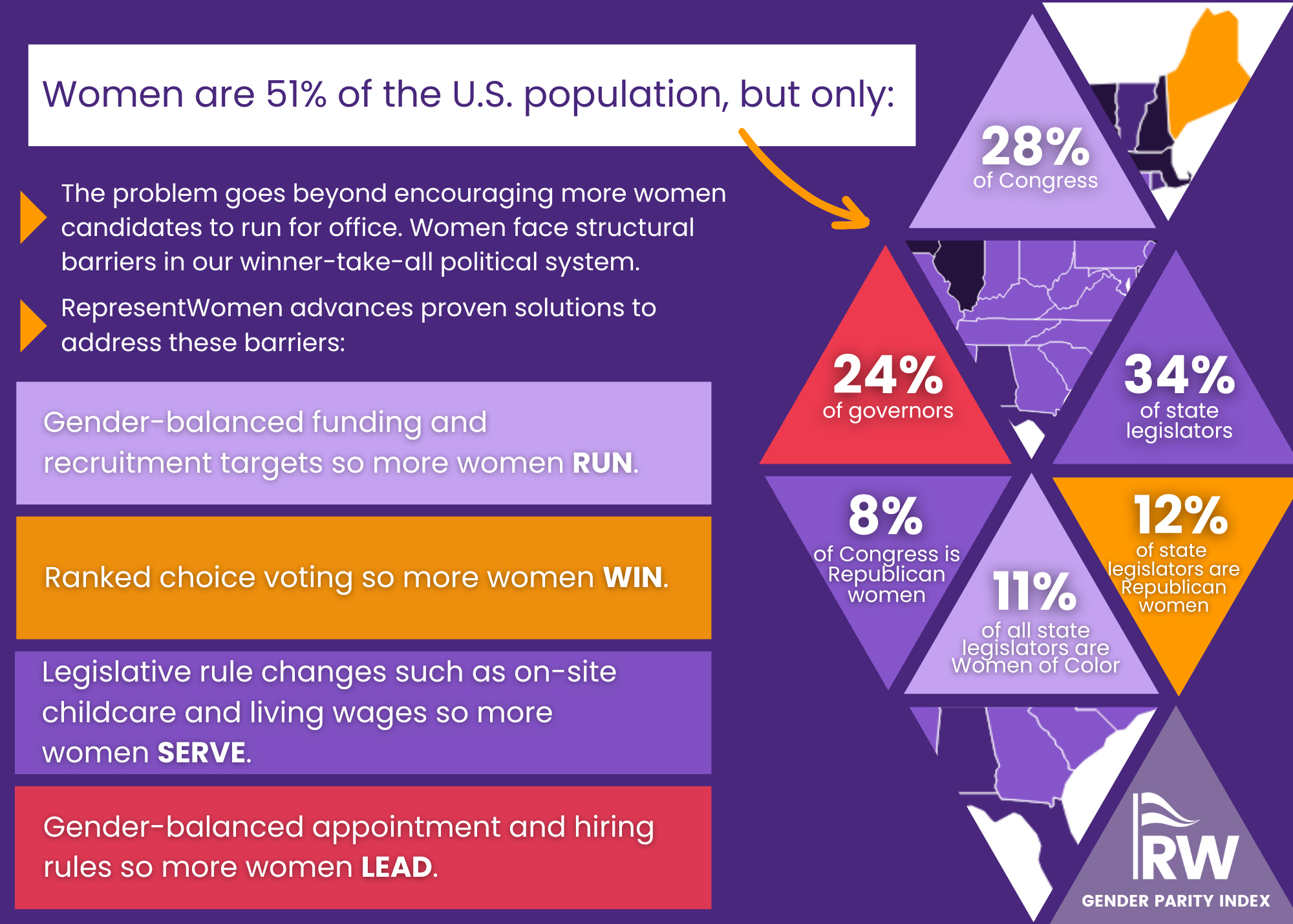
Why the GPI matters (at a glance)
The numbers below show the gap — and the systems solutions that move the needle.
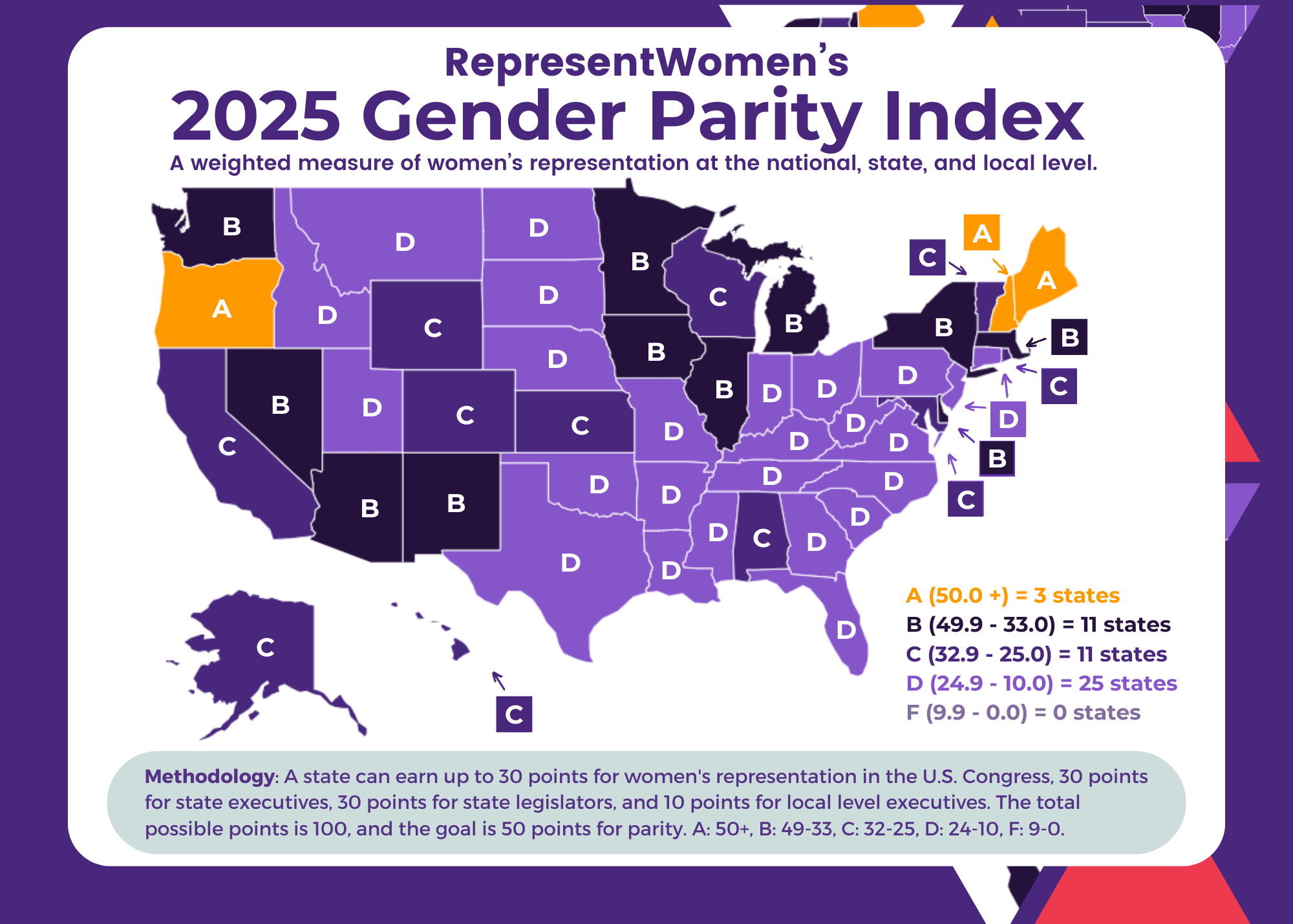
2025 Gender Parity Index Map
How did your state score on the GPI? Check the map below to track your state's progress.
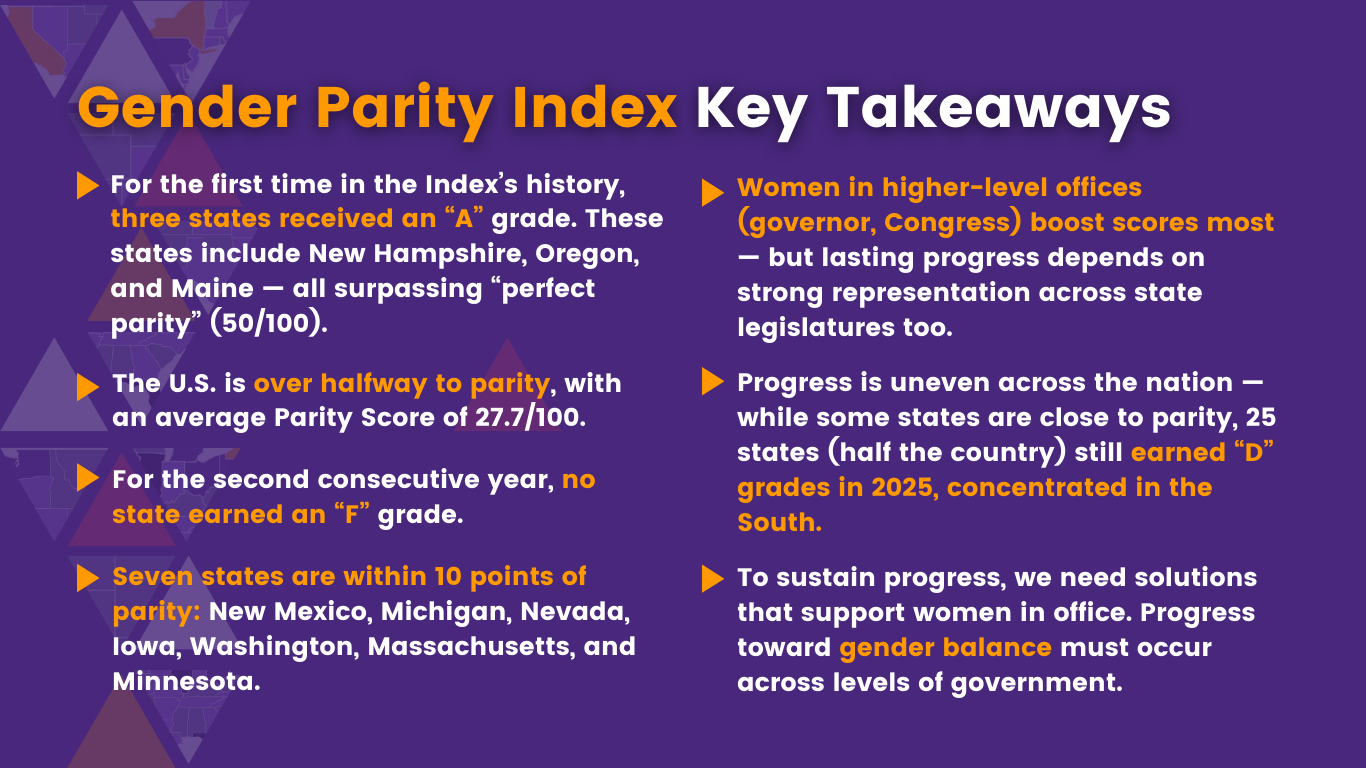
Key Findings
Invite Us to Present the Gender Parity Index
Want to bring the GPI to your organization, campus, or community? Our team can present the latest findings, walk through the methodology, and discuss actionable strategies to advance women’s representation.
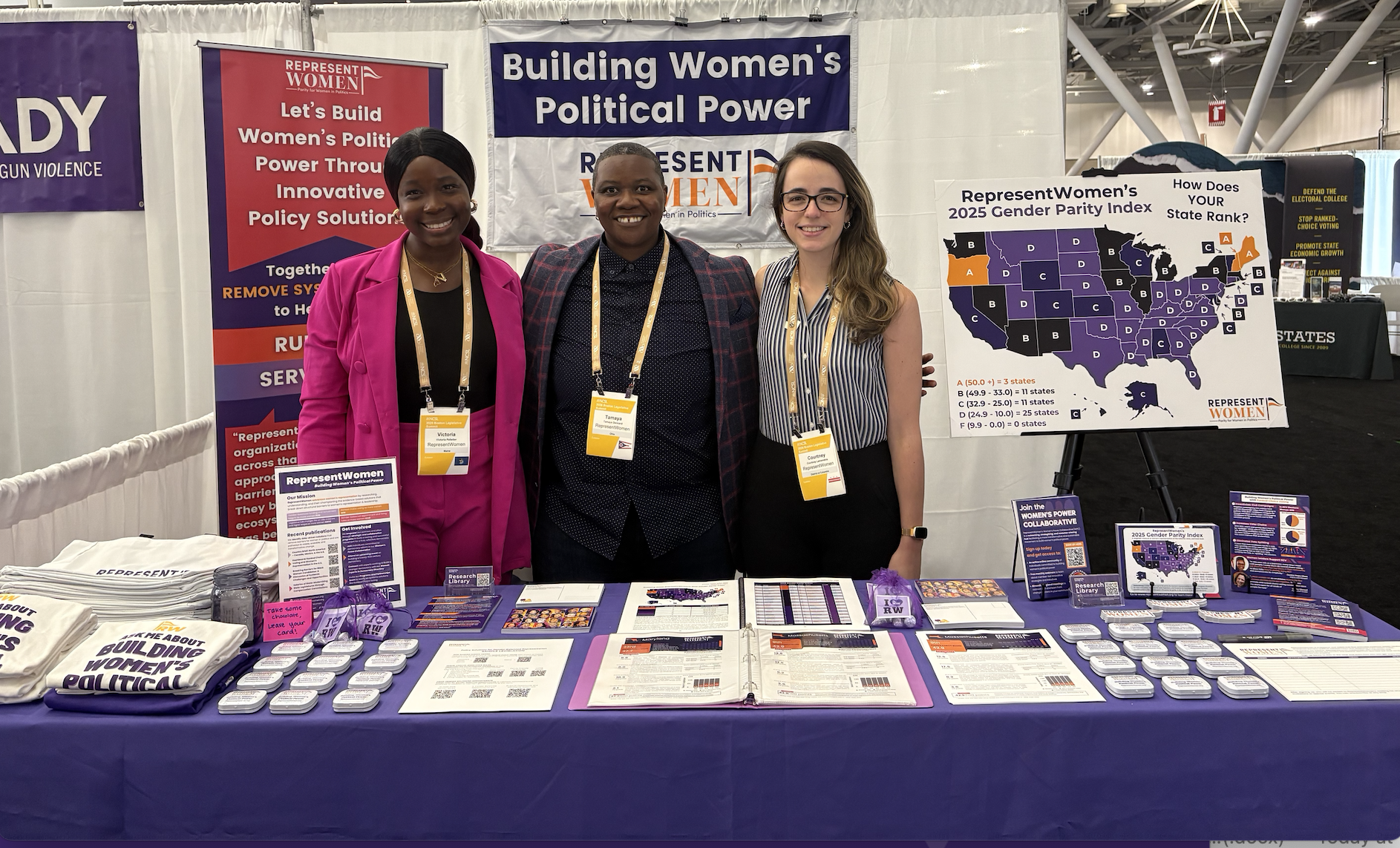
Looking Back: The Launch of the GPI in 2013
The Gender Parity Index was first introduced in 2013 at an NYU panel moderated by RepresentWomen’s founder, Cynthia Richie Terrell. More than a decade later, the concerns raised then remain urgent today — underscoring the consistency, longevity, and continued relevance of the GPI.
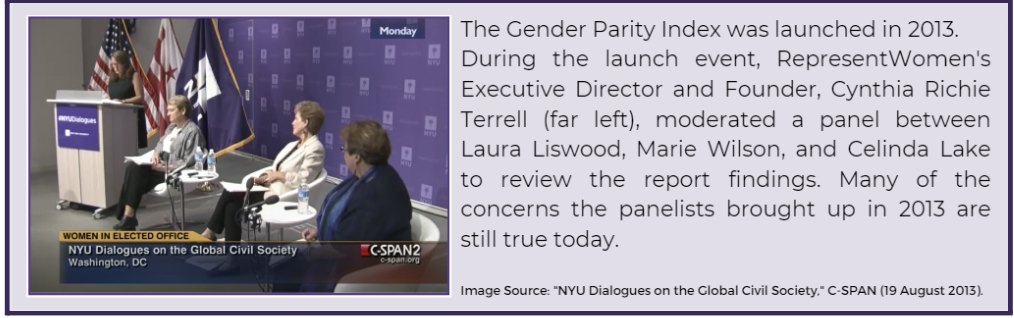
Listen in to learn how the Gender Parity Index began — and how its origins continue to shape the data behind today’s 2025 report.
Explore Past Gender Parity Index Reports
The Gender Parity Index has been tracking women’s representation across the United States for over a decade. Each year builds on the last, offering a clearer picture of where progress is happening — and where barriers remain.
Check out the most recent past editions below to see how the conversation has evolved leading up to the 2025 report.
Stay in the loop
Want to keep up with the latest on women’s representation? Make sure to sign up for our email updates! You’ll get:
-
Thought Leadership — our new weekly thought leadership newsletter (launching soon) from the RepresentWomen team.
-
Spotlight storytelling — features on organizations, states, and women leaders driving change.
-
Invitations to events — join conversations and actions that move the needle for women’s representation.
-
Weekend Reading — Cynthia Richie Terrell’s popular Friday roundup of news and insights.

-